Research Highlights
Research Highlights
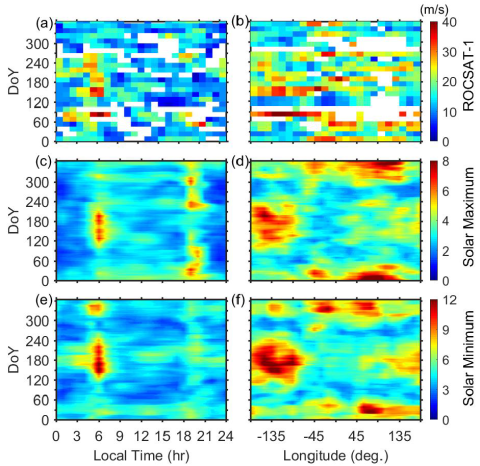
Quiet-time Day-to-day Variability of Equatorial Vertical E×B Drift from Atmosphere Perturbations at Dawn
The ionosphere is different from one day to the next, even under geomagnetic and solar quiet condition. The vertical E×B drift at the geomagnetic equator is a key parameter that influences the state of the ionosphere and atmosphere. In this paper, we study the quiet-time day-to-day variability of the equatorial vertical E×B drift by ROCSAT-1 observations and the Whole Atmosphere Community Climate Model with thermosphere and ionosphere eXtension (WACCM-X) v2.1 simulations.
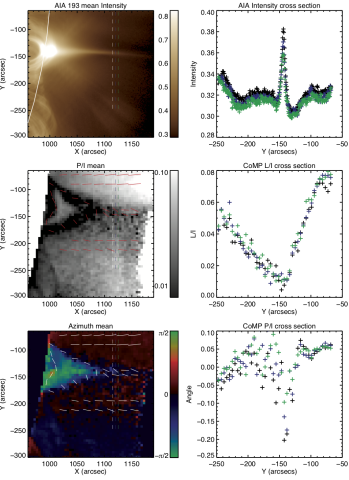
Spectropolarimetric Insight into Plasma-Sheet Dynamics of a Solar Flare
We examine spectropolarimetric data from the CoMP instrument, acquired during the evolution of the September 10th 2017 X8.2 solar flare on the western solar limb. CoMP captured linearly polarized light from two emission lines of Fe XIII at 1074.7 and 1079.8 nm, from 1.03 to 1.5 solar radii. We focus here on the hot plasma-sheet lying above the bright flare loops and beneath the ejected CME.
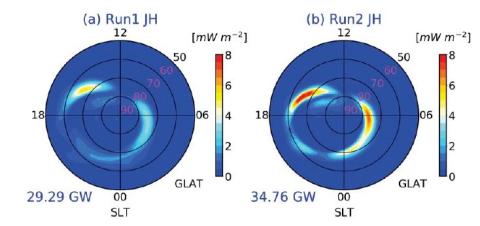
Impacts of binning methods on high-latitude electrodynamic forcing: static vs boundary oriented binning methods
The Earth’s atmosphere is coupled at high latitude to the magnetosphere. This is a crucial region since energy is put into the upper atmosphere of Earth and is redistributed globally. Numerical models such as general circulation models (GCMs) simulate the effects of the high latitude energy input on the thermosphere-ionosphere system.
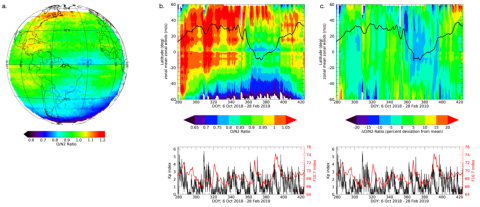
Thermospheric composition O/N2 response to an altered meridional mean circulation during Sudden Stratospheric Warmings observed by GOLD
GOLD measurements provide the first observational proof of model predictions that the break up of the stratospheric polar vortex changes the composition of the thermosphere.
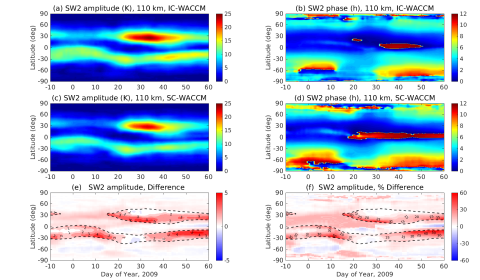
On the importance of interactive ozone chemistry in Earth-System models for studying MLT tidal changes during sudden stratospheric warmings
We use the CESM2-WACCM, to study the importance of ozone in the vertical coupling between lower and upper atmosphere during SSWs. During SSWs, the build-up of stratospheric ozone concentrations at tropical latitudes and its increased asymmetrical distribution carries the potential to affect the generation of migrating and non-migrating semidiurnal solar tides.
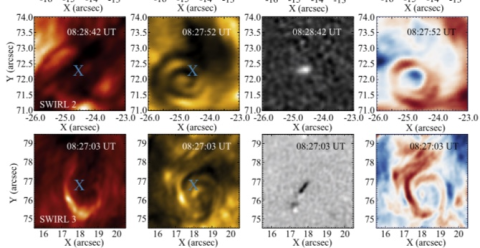
Multiwavelength High-resolution Observations of Chromospheric Swirls in the Quiet Sun
We report observations of small-scale swirls seen in the solar chromosphere. They are typically 2 Mm in diameter and last around 10 minutes. Using spectropolarimetric observations obtained by the CRisp Imaging Spectro- Polarimeter at the Swedish 1 m Solar Telescope, we identify and study a set of swirls in chromospheric Ca II 8542 Å and Hα lines as well as in the photospheric Fe I line.
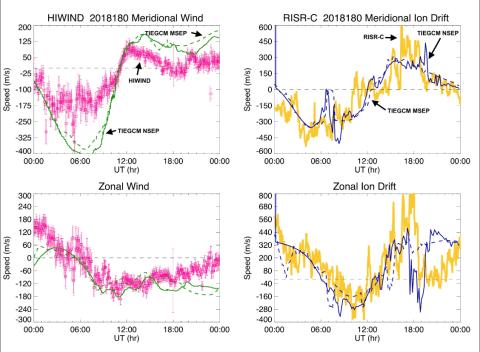
HIWIND Observation of Summer Season Polar Cap Thermospheric Winds
HIWIND (High altitude Interferometer WIND experiment) is a balloon borne Fabry Perot interferometer (FPI) for daytime thermospheric wind observations. In this paper, we examine the summer polar cap thermospheric winds observed by HIWIND with the RISR-C (Resolute Incoherent Scatter Radar-Canada) observed ion drifts and electron densities.
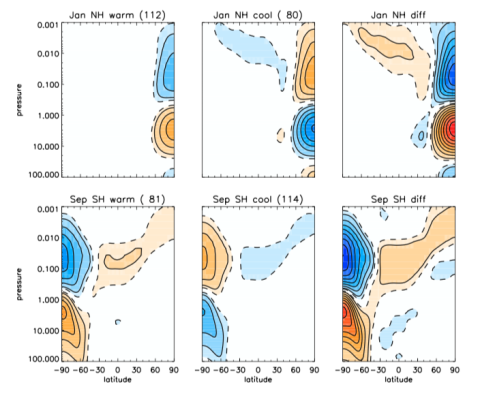
Interhemispheric Coupling Mechanisms in the Middle Atmosphere of WACCM6
Simulations with the Community Earth System Model 2 using the Whole Atmosphere Community Climate Model configuration, known as CESM2(WACCM6), show evidence of dynamical coupling from the high latitudes of the winter middle atmosphere to the tropics and the middle and high latitudes of the summer hemisphere.
Sun-Like Stars Shed Light on Solar Climate Forcing
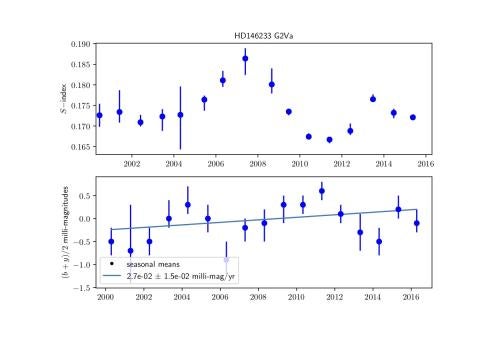
Recently published, precise stellar photometry of 72 Sun-like stars obtained at the Fairborn Observatory between 1993 and 2017 is used to set limits on the solar forcing of Earth’s atmosphere of ±4.5 W m−2 since 1750. This compares with the +2.2 ± 1.1 W m−2 IPCC estimate for anthropogenic forcing.