Research Highlights
Research Highlights
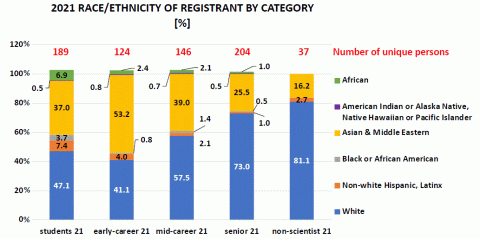
Assessing the Demographics of the 2021 and 2022 CEDAR Workshop
McArthur Jones and Astrid Maute report the demographic information obtained for the 2021 virtual workshop and 2022 in-person workshop. In general, the demographics of CEDAR are consistent with those in the broader science, technology, engineering, and mathematics (STEM) fields, that is, most participants identify as male, White, and/ or Asian/Middle Eastern.
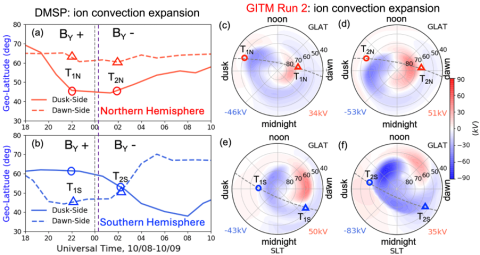
Inter-Hemispheric Asymmetries in the High-Latitude Electrodynamic Forcing and the Thermosphere During the October 8-9, 2012 Geomagnetic Storm: An Integrated Data-Model Investigation
Y. Hong, Y. Deng, Q. Zhu, A. Maute, M. Hairston, C. Sheng, D. Welling, R. Lopez utilize field-aligned currents (FACs) obtained from the Active Magnetosphere and Planetary Electrodynamics Response Experiment data set to specify the high-latitude electric potential in the Global Ionosphere and Thermosphere Model (GITM) to examine the IHAs in the IT system during the 8-9 October 2012 storm.
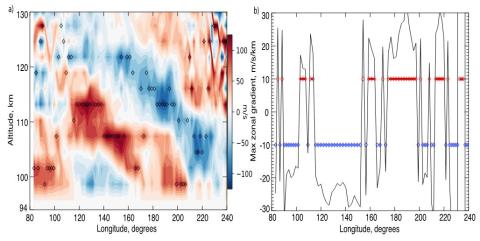
Horizontal wind shears in the lower thermosphere observed by ICON
S. L. England, C. R. Englert, B. J. Harding, C. C. Triplett, K. Marr, J.M. Harlander, G.R. Swenson, A. Maute, and T. Immel make observations from the MIGHTI instrument on board the Ionospheric Connection Explorer are analyzed to determine the maximum wind shear in the 95-120 km region during the day time. The strong shear occurrence, horizontal scale and underlying organization is examined.
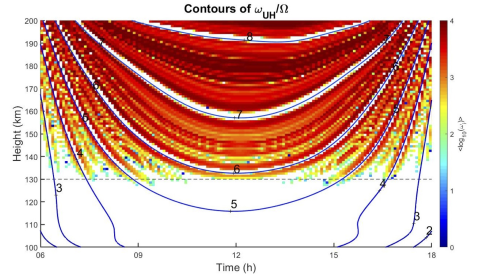
The photoelectron driven upper hybrid instability as the cause of 150 km echoes
Nicholas Pedatella discusses strong, unexplained echoes returning from altitudes of 130–170 km in the atmosphere; how all radars work by reflecting radio waves off a target and measuring the returned signal. This region (130–170 km) in the upper atmosphere is likely to create and maintain a specific set of plasma waves that act as a coherent structure for radar measurements.
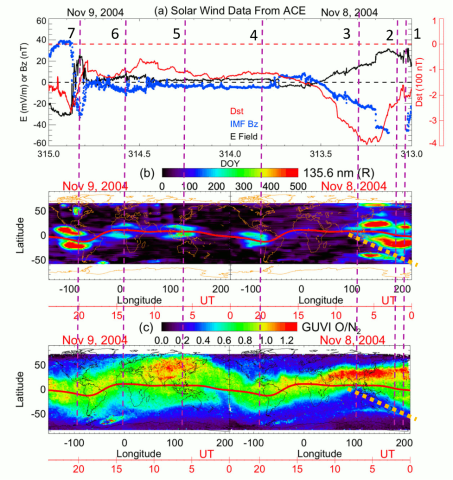
FUV Observations of Variations in Thermospheric Composition and Topside Ionospheric Density During the November 2004 Magnetic Superstorm
Y. Zhang, L. Paxton, C. Huang, and W. Wang, observe that the 135.6 nm radiances clearly showed a signature of ionospheric equatorial arcs and their variations during the November 2004 magnetic superstorm. When an intense eastward Interplanetary Electric Field (IEF) occurred, the dayside equatorial arcs were enhanced and their latitude separation increased.
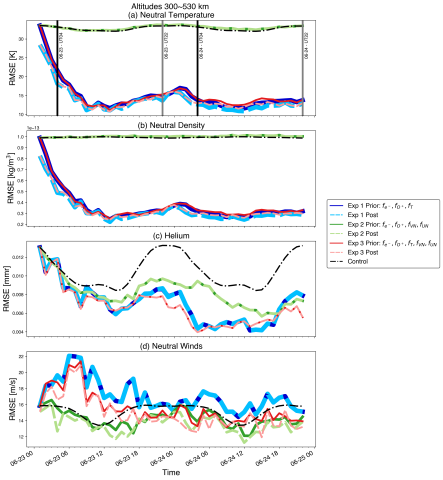
Specifying Satellite Drag Through Coupled Thermosphere-Ionosphere Data Assimilation of Radio Occultation Electron Density Profiles Publication: Space Weather
Nicholas Dietrich, Tomoko Matsuo, Chih-Ting Hsu for the first time, successfully estimate helium compositions with plasma observations, where helium has virtually no observations and becomes dominant at high altitudes. Their study further develops the potential use of a large and growing source of plasma data to predict the Earth orbital environment.
![Simulations of hemispherically integrated Joule heating [GW] polewardd](png/maute_integratedjouleheating2020487d.png)
Magnetosphere-ionosphere coupling via prescribed field-aligned current simulated by the TIEGCM
A. Maute, A.D. Richmond, G. Lu, D. Knipp, Y. Shi, B. Anderson assert that the magnetosphere-ionosphere (MI) coupling is crucial in modeling the thermosphere-ionosphere (TI) response to geomagnetic activity. They introduce a new method using observed FAC and solve for the interhemispherically asymmetric electric potential distribution.
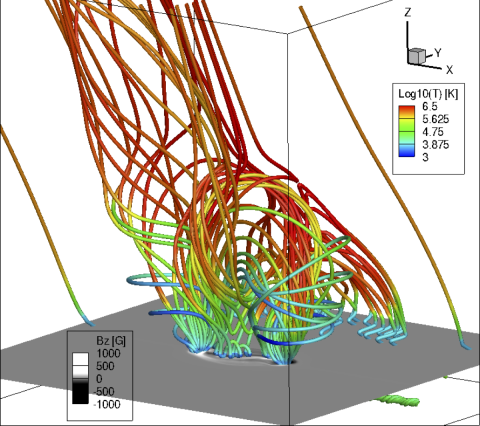
Validation of the PDFI SS method for electric field inversions using magnetic flux emergence simulations
A.N. Afanasyev, M.D. Kazachenko, Y. Fan, G.H. Fisher, and B. Tremblay further validate the PDFI SS method, using approximately one–hour long MHD simulation data of magnetic flux emergence from the upper convection zone into the solar atmosphere. They reconstruct photo- spheric electric fields and calculate the Poynting flux, and compare those to the actual values from the simulations.
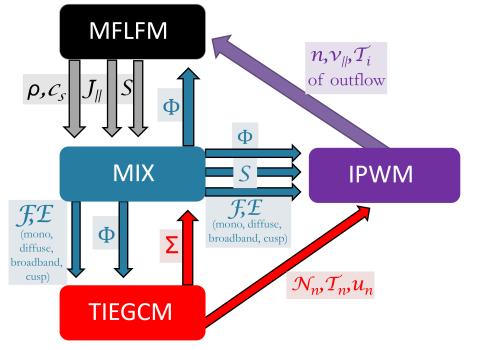
Thermospheric Impact on the Magnetosphere through Ionospheric Outflow
Kevin Pham, William Lotko, Roger Varney, Binzheng Zhang, Jing Liu have taken a key step in evaluating the importance of ionospheric outflows relative to electrodynamic coupling in the thermosphere’s impact on geospace dynamics. Their simulation results identify a variety of observed magnetospheric features that are attributable directly to the thermosphere’s material influence.